
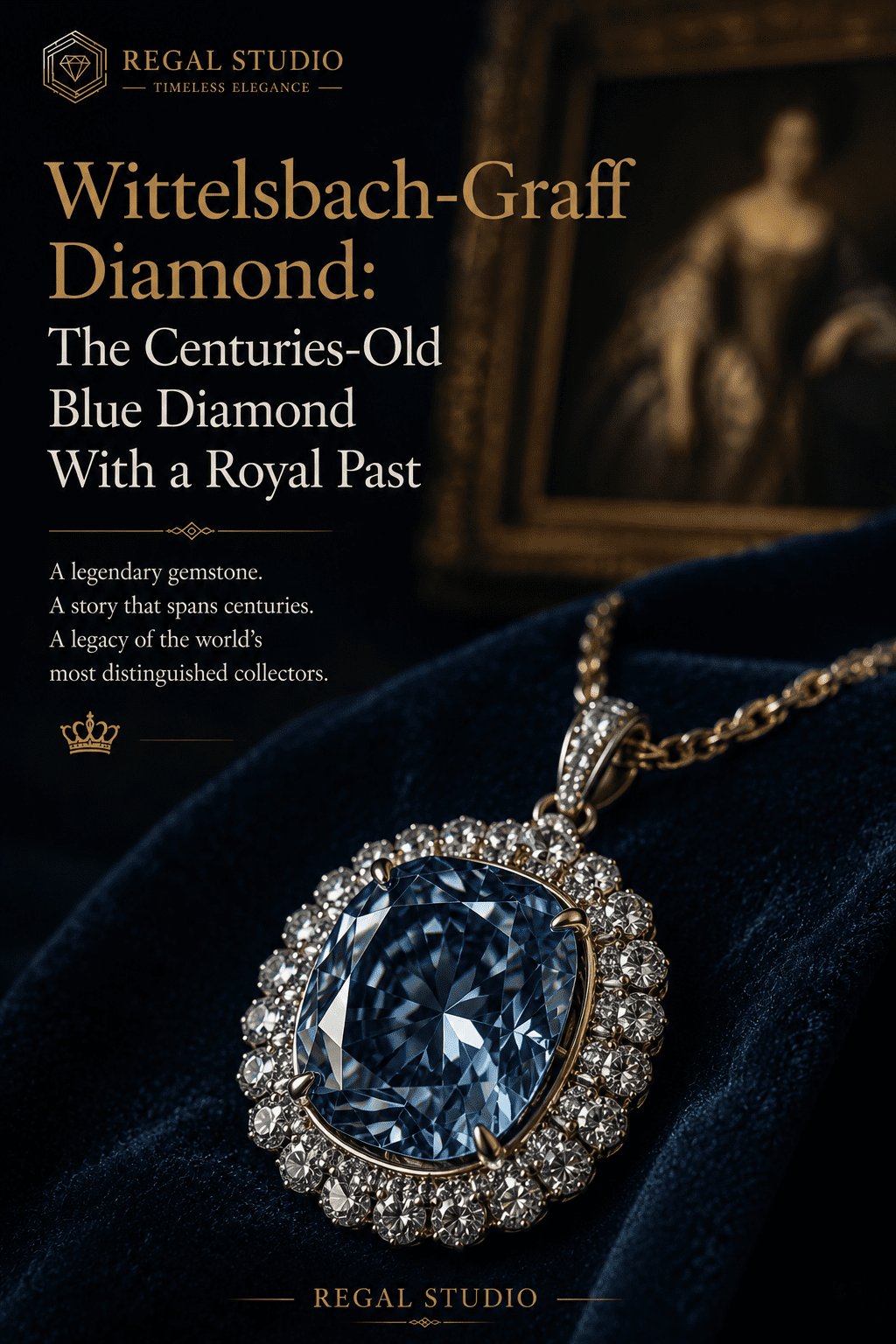


Wittelsbach-Graff Diamond: The Centuries-Old Blue Diamond With a Royal Past
The Wittelsbach-Graff Diamond is a 31.06-carat Fancy Deep Blue Internally Flawless cushion-cut diamond with a documented royal provenance dating back to 1664. Originally weighing 35.56 carats and known as Der Blaue Wittelsbacher, the stone passed through the dowry of Spanish Infanta Margarita Teresa, the Austrian Habsburg court, and finally the Bavarian Wittelsbach royal family, where it served as the centerpiece of the Bavarian royal crown from 1806 until the monarchy ended in 1918. After disappearing for decades, it sold for $24.3 million at Christie’s London in December 2008 to British jeweler Laurence Graff, who controversially recut it from 35.56 to 31.06 carats to remove flaws and improve color, transforming the stone from Fancy Deep Grayish-Blue to Fancy Deep Blue and from VS2 clarity to Internally Flawless. Today it stands as the largest Internally Flawless Fancy Deep Blue diamond ever graded by GIA.
In our market observations across more than four decades of diamond grading and the high-end colored stone market, the Wittelsbach-Graff is one of the three most historically significant blue diamonds in the world, alongside the Hope Diamond and the Oppenheimer Blue. Experience has shown that understanding this single stone teaches more about diamond provenance, royal jewelry traditions, and the controversies surrounding modern recutting than any other historic gem.
The Wittelsbach-Graff Diamond at a Glance
Before exploring the full story, here are the essential facts every collector should know.
Attribute | Detail |
Original carat weight | 35.56 carats (as Wittelsbach Diamond) |
Post-recut weight | 31.06 carats (as Wittelsbach-Graff) |
Original color grade | Fancy Deep Grayish-Blue |
Post-recut color grade | Fancy Deep Blue |
Original clarity | VS2 (Very Slightly Included 2) |
Post-recut clarity | Internally Flawless (IF) |
Cut | Cushion (modified brilliant) |
Diamond type | Type IIb (boron-induced blue) |
Origin | Kollur mines, Golconda region, India |
First documented | Around 1664 (Spain), recorded in Vienna circa 1722 |
2008 auction date | December 10, 2008 |
2008 auction house | Christie’s London |
2008 hammer price | $24,262,008 USD (£16.4 million) |
2008 buyer | Laurence Graff |
Recut completed | January 2010 |
Carats sacrificed in recut | 4.45 carats (890 mg) |
Smithsonian display | January 28 – August 1, 2010 (alongside Hope Diamond) |
Special feature | Red phosphorescence under UV (similar to Hope Diamond) |
A key insight often overlooked: the Wittelsbach-Graff and the Hope Diamond have remarkably similar properties (both Type IIb, both from India, both exhibit red phosphorescence), but Smithsonian scientific analysis confirmed they did NOT originate from the same crystal. They formed under similar geological conditions in the Golconda region but as separate stones.
The 400-Year Royal Journey
The Wittelsbach-Graff has one of the longest documented provenances of any diamond in the world. Its journey through European royal courts spans more than three and a half centuries.
1664: The Spanish Royal Court
The traditional story holds that in 1664, King Philip IV of Spain selected the blue diamond for the dowry of his teenage daughter, Infanta Margarita Teresa, upon her engagement to Emperor Leopold I of Austria, the Holy Roman Emperor.
Some historians note that the original Spanish records were destroyed during the Spanish Civil War, leaving the earliest documentation about 50 years later when the stone was already in Vienna. Either way, the diamond’s path through royal European hands is documented from this period forward.
In our professional assessment, the Spanish royal connection is part of the diamond’s enduring romantic appeal. Whether the precise 1664 dowry story is fully verifiable or partly apocryphal, the diamond’s path through the Habsburg-Wittelsbach royal lines is one of the most thoroughly documented royal jewelry chains in history.
1664-1722: The Habsburg Years
After Infanta Margarita Teresa’s untimely death in 1675 at age 21, the diamond passed through the Austrian Habsburg royal family:
- Inherited by Emperor Leopold I (Margarita Teresa’s husband)
- Passed to Empress Eleonore Magdalena (Leopold’s third wife)
- Bequeathed to Archduchess Maria Amalia (Leopold’s granddaughter)
Throughout this period, the diamond was likely set in various royal jewelry pieces and worn at major court ceremonies of the Habsburg dynasty.
1722: The Wittelsbach Family Inheritance
In 1722, Archduchess Maria Amalia of Austria married Bavarian Crown Prince Charles Albert. As part of her dowry, the blue diamond entered the Bavarian Wittelsbach royal collection, where it would acquire its permanent name.
The diamond’s value at this transfer was assessed at 240,000 guilders (approximately $135,593 in modern reference). A portrait painted of Maria Amalia at her 1722 wedding is the oldest surviving visual record of the diamond.
1742-1761: The Order of the Golden Fleece
When Charles Albert was crowned Emperor of Bavaria in 1742, the blue diamond was set into a crown reminiscent of the Ottonian Empire crowns. The stone became firmly established as the Wittelsbach family’s most sacred emblem.
In 1761, Elector Maximilian III Joseph (Charles Albert’s son) had the diamond mounted in a badge of the Order of the Golden Fleece, an elaborate brooch design featuring the Wittelsbach Blue surrounded by:
- Over 700 smaller diamonds
- Yellow and white diamonds in the outer setting
- A diamond-paved golden ram representing the Order
This Order of the Golden Fleece mounting represented the diamond at its most ceremonially significant.
1806-1918: The Bavarian Crown
In 1806, when Maximilian IV Joseph became the first King of Bavaria, he commissioned a royal crown that prominently featured the blue diamond at its apex. For over a century, the Wittelsbach Blue resided atop the Bavarian crown, displayed in the Treasury of the Munich Residence.
The diamond witnessed:
- Maximilian I Joseph’s coronation
- State ceremonies and parliamentary openings
- Official portraits of Bavarian monarchs
- The reign of King Ludwig II (the famous “Mad King” who built Neuschwanstein Castle)
- Generations of Wittelsbach kings
The diamond’s last public appearance during the Bavarian monarchy was at King Ludwig III’s funeral in 1921, three years after Bavaria became a republic following World War I.
A key insight often overlooked: the Wittelsbach Blue is one of the very few historical diamonds with continuous documented royal use spanning multiple centuries. Most “famous” diamonds with royal histories were stored in vaults rather than actively worn at state ceremonies.

The Disappearance and Mystery (1931-1962)
The Wittelsbach Diamond’s history takes a strange and partly mysterious turn in the 20th century.
The 1931 Christie’s Auction
After World War I, the Wittelsbach family faced severe financial difficulties. The German government permitted them to sell 13 of the Crown Jewels, including the Wittelsbach Blue. In 1931, Christie’s London listed the diamond at auction.
The bidding reached only £5,400, and the stone reportedly failed to meet its reserve. According to some accounts, the actual diamond disappeared before the auction and was replaced by a worthless piece of cut blue glass.
The 30+ Year Disappearance
For more than three decades after the 1931 auction, the Wittelsbach Diamond’s whereabouts were unknown to the public. The actual stone reportedly resurfaced in Belgium in 1951 but remained unattributed.
In 1958, an unidentified blue diamond was exhibited at the World Expo in Brussels. Few visitors realized they were looking at the long-lost Wittelsbach Blue.
1962: Joseph Komkommer’s Recognition
The Wittelsbach Diamond was correctly identified in 1962 by Belgian jeweler Joseph Komkommer. According to multiple historical accounts, Komkommer was asked to evaluate a “mystery diamond” for potential recutting by the Goldmuntz family, who had acquired the stone.
When Komkommer opened the package, he immediately recognized the historical significance of the Wittelsbach Diamond. Concerned that recutting would destroy its historical value, he refused to perform the work. Instead, he organized a group of dealers to purchase the stone collectively to preserve it.
In our market observations, Joseph Komkommer’s recognition of the stone in 1962 may be the single most important act of historical preservation in 20th century diamond history. Without his refusal to recut and his coordinated purchase, the original Wittelsbach Diamond would likely have been lost to history decades earlier.
1964-2008: The Horten Years
In 1964, German businessman Helmut Horten purchased the Wittelsbach Diamond and presented it to his wife Heidi as a wedding gift. The diamond remained in the Horten family’s private collection for over four decades, rarely seen by the public.
After Helmut Horten’s death, the diamond was eventually consigned to Christie’s London for the 2008 auction that would transform its modern history.
The 2008 Auction and Laurence Graff
The Wittelsbach Diamond’s December 2008 sale was one of the most consequential single-jewel auctions of the 21st century.
Pre-Auction Context
Christie’s experts meticulously verified the diamond’s provenance, tracing it back to 1664 through royal inventories from the Spanish, Austrian, and Bavarian courts. The diamond was offered as the highlight of Christie’s December 10, 2008 “Jewels: The London Sale.”
Industry experts expected the diamond to sell for approximately $15 million, in the range of other major historic stones at the time.
The Sale
On December 10, 2008, the hammer fell at $24,262,008 USD (£16.4 million) including buyer’s premium, far exceeding pre-sale estimates and setting a world record for any diamond sold at auction at that time.
The buyer was British jeweler Laurence Graff of Graff Diamonds, who would later describe the purchase as “the pinnacle of his career.”
Henri Barguirdjian, then-president and CEO of Graff Diamonds USA, captured what made the diamond special: “The provenance of a gem is important in ways that are not true of other things. With the Wittelsbach blue, you knew how it came into existence and in a rather exciting way. You know who has worn it, what kinds of historical events it has gone through and what social upheavals it was present for.”
A key insight often overlooked: the 2008 sale at $24.3 million held the world record for “most expensive diamond sold at auction” until 2010, when it was surpassed by the Graff Pink at $46.2 million, also purchased by Laurence Graff.
The Controversial Recut
After acquiring the Wittelsbach in 2008, Laurence Graff made the most controversial decision in modern diamond history: he ordered the historic stone to be recut.
Graff’s Rationale
In January 2010, Graff revealed that he had commissioned three master diamond cutters to remove flaws from the historic stone. The recut sacrificed:
- 4.45 carats (890 mg) of weight (from 35.56 to 31.06 carats)
- Some surface bruises and chips accumulated over centuries
- The original 82-facet cutting pattern
Graff defended his decision: “I decided that to create beauty, or acts of beauty, is not a sin. All we did was remove the blemishes and now it’s true perfection.”
The Results
The recut transformed the stone:
- Weight: 35.56 → 31.06 carats (4.45 carat sacrifice)
- Color: Fancy Deep Grayish-Blue → Fancy Deep Blue (cleaner, more vivid)
- Clarity: VS2 → Internally Flawless (highest clarity grade)
- GIA designation: largest Internally Flawless Fancy Deep Blue ever graded
By technical grading metrics, the recut Wittelsbach-Graff is now objectively a finer diamond than the original Wittelsbach.
The Backlash
The recount sparked intense criticism from gemologists, historians, and the German cultural establishment.
Notable critics included:
- Gabriel Tolkowsky (legendary diamond cutter): called the recut “the end of culture”
- Professor Hans Ottomeyer (director of Deutsches Historisches Museum, Berlin): compared the recut to “the overpainting of a painting by Rembrandt”
- Scott Sucher (American gem cutter): noted that “in the case of the Wittelsbach, what’s at stake is at minimum over 350 years of history, as every nick, chip, and scratch has a story to tell”
- General German cultural opinion: viewed the alteration as destruction of national heritage
In our professional assessment, the Wittelsbach-Graff recut represents one of the most genuine ethical debates in modern gemology. Both perspectives have merit. The recut undeniably created a more visually stunning diamond. It also destroyed irreplaceable historical context that had survived for 350+ years.
The Smithsonian Exhibition
In 2010, after the recut, Laurence Graff loaned the Wittelsbach-Graff to the Smithsonian’s National Museum of Natural History for a six-month exhibition (January 28 – August 1, 2010).
The diamond was displayed alongside the Hope Diamond, marking the first time these two legendary blue diamonds had been shown together publicly. Both stones share remarkable similarities:
- Both originated from India’s Golconda mines
- Both are Type IIb diamonds (boron-induced blue)
- Both exhibit rare red phosphorescence under UV light
- Both have spent centuries in royal collections
The Smithsonian Scientific Investigation
During the Wittelsbach-Graff’s residence at the Smithsonian, researchers conducted detailed analysis to determine whether the two diamonds shared a common crystal origin.
The Smithsonian’s findings:
- Both diamonds share remarkable similarities in chemistry and properties
- Both formed in similar geological conditions in India
- However, they did NOT originate from the same crystal
- Small but significant differences were observed in their red phosphorescence (the Wittelsbach-Graff’s is slightly longer and more intense)
- Different luminescence patterns were observed under DiamondView analysis
A key insight often overlooked: the Smithsonian’s confirmation that these are two separate diamonds (rather than fragments of the same original crystal) is one of the most important scientific findings in modern gemological research.

The Wittelsbach-Graff in Context: Most Famous Blue Diamonds
To fully appreciate the Wittelsbach-Graff’s significance, see how it compares to other legendary blue diamonds.
Diamond | Carats | Color | Status | Historical Era |
Hope Diamond | 45.52 | Fancy Deep Grayish-Blue | Smithsonian, est. $250M | 17th century-present |
Wittelsbach-Graff | 31.06 | Fancy Deep Blue (IF) | Private (Graff) | 1664-present |
Cullinan Dream | 24.18 | Fancy Intense Blue | Christie’s $25.4M (2016) | Modern (Cullinan mine) |
Oppenheimer Blue | 14.62 | Fancy Vivid Blue | Christie’s $57.5M (2016) | Modern (Oppenheimer family) |
De Beers Cullinan Blue | 15.10 | Fancy Vivid Blue | Sotheby’s $57.5M (2022) | Modern |
Blue Moon of Josephine | 12.03 | Fancy Vivid Blue | Sotheby’s $48.4M (2015) | Modern (Cullinan mine) |
Heart of Eternity | 27.64 | Fancy Vivid Blue | De Beers/Private | Modern (Premier mine) |
In our market observations, the Wittelsbach-Graff occupies a unique position: it has both the historic gravitas of stones like the Hope Diamond AND the technical perfection (Internally Flawless) of modern record-breakers. No other blue diamond combines these two characteristics.
The Type IIb Chemistry Connection to the Hope Diamond
The Wittelsbach-Graff and Hope Diamond’s shared Type IIb classification reveals one of the most fascinating chapters in geological history.
What Type IIb Means
Type IIb diamonds are the chemically distinct category that contains boron atoms substituted for some carbon atoms in the crystal structure. The boron content creates natural blue color in diamonds.
Key facts about Type IIb diamonds:
- Less than 0.1% of all natural diamonds qualify as Type IIb
- Boron content makes Type IIb diamonds electrically conductive (most diamonds are not)
- All major fancy blue diamonds (Hope, Wittelsbach-Graff, Oppenheimer, Blue Moon, Cullinan Dream) are Type IIb
- The blue color saturation is directly proportional to boron concentration
The Phosphorescence Phenomenon
The Wittelsbach-Graff exhibits the same rare red phosphorescence as the Hope Diamond. When exposed to UV light and then the light is removed, both diamonds glow red for several seconds before the glow fades.
This shared phosphorescence behavior is one of the strongest pieces of evidence connecting these stones to similar geological origins in India’s Golconda region. While they are not the same crystal, they likely formed under similar conditions in the same general geological era.
A key insight often overlooked: the red phosphorescence of Type IIb blue diamonds is one of the most beautiful and least understood phenomena in gemology. The exact mechanism is still subject to ongoing scientific research.
Where Is the Wittelsbach-Graff Diamond Today?
The Wittelsbach-Graff Diamond is currently held in Laurence Graff’s private collection at Graff Diamonds.
Current status of the Wittelsbach-Graff:
- Privately held by Laurence Graff and Graff Diamonds
- Not currently on public display
- Estimated current value: $80-120 million+ (reflecting historical significance and current blue diamond market)
- Insurance valuation likely significantly higher
- No announced plans for resale
In our market observations, diamonds with this level of historical significance and Graff’s personal attachment rarely return to public auction. The Wittelsbach-Graff may not appear at public sale for decades.
What the Wittelsbach-Graff Teaches Today’s Buyers
For collectors and historians, the Wittelsbach-Graff story offers four practical lessons that apply to anyone interested in colored diamonds.
Four lessons from the Wittelsbach-Graff:
- Provenance is finite and irreplaceable. Once historical context is destroyed (through recutting, resetting, or undocumented ownership transfers), it cannot be restored. Always preserve documentation, original settings, and historical records when handling diamonds with provenance.
- The “perfection vs heritage” debate has no perfect answer. The Wittelsbach-Graff recut created a more visually perfect diamond. It also destroyed irreplaceable historical artifact value. Both perspectives have merit, and serious collectors should think carefully about how this trade-off applies to their own pieces.
- Type IIb chemistry remains rare and valuable. Whether ancient or modern, Type IIb blue diamonds command extraordinary premiums. Understanding the chemistry behind blue color is essential for evaluating any blue diamond purchase.
- A trusted jeweler relationship matters more for historic stones than for new diamonds. Experience has shown that the technical complexity of provenance verification, treatment risks, and historical valuation demand expertise no individual collector can match alone.
Expert Analysis: Five Truths About the Wittelsbach-Graff Diamond
In our market observations across more than four decades of diamond expertise, the Wittelsbach-Graff represents five patterns that shape historic colored diamond economics.
Five insights from the bench:
- The Wittelsbach-Graff is one of only a handful of diamonds with continuous 350+ year documented royal use. Most “famous” historical diamonds were stored in vaults; the Wittelsbach was actually worn at state ceremonies for over a century in Bavaria alone. This active ceremonial history makes it genuinely unique.
- Joseph Komkommer’s 1962 recognition saved an irreplaceable artifact. Experience has shown that single moments of expert intervention can preserve diamonds for future generations. Without Komkommer, the original Wittelsbach Diamond would likely have been lost to recutting decades earlier than it eventually was.
- The recut controversy is the most important ethical debate in modern gemology. No single decision about a diamond has generated more passionate debate among experts than Graff’s recut. The debate continues today and will likely never be definitively resolved.
- The Smithsonian’s Hope-Wittelsbach comparison is foundational research. The 2010 scientific analysis comparing these two stones provided definitive answers to questions that had been speculated about for centuries. This is the kind of research that advances the entire field of gemology.
- A trusted jeweler relationship matters more for historic stones than for any other category. The technical complexity of Type IIb verification, provenance documentation, and historical valuation demands expertise that takes decades to develop.

How GIA Experts Authenticate Historic Blue Diamonds
Beyond standard diamond authentication, professional historic blue diamond evaluation includes:
- Color origin determination: natural vs. treated (5-10x value difference)
- Type designation: Type IIb confirmation via spectroscopy
- Phosphorescence observation: red glow under UV light for some Type IIb diamonds
- Electrical conductivity testing: Type IIb diamonds conduct electricity
- Provenance verification: royal inventories, auction records, documented ownership chains
- Historical photography matching: comparing modern diamond to historical visual records
- Spectroscopic analysis: confirms natural boron-induced color
- Cutting style analysis: identifying period-appropriate facet patterns
Buyers can learn the basics. Mastering historic colored diamond authentication takes years of dedicated study. That is why a relationship with a GIA Certified Diamond Grader is essential for any serious colored diamond purchase.
Frequently Asked Questions About the Wittelsbach-Graff Diamond
What is the history of the Wittelsbach-Graff Diamond?
The Wittelsbach-Graff Diamond originates from the Kollur mines in India’s Golconda region. Its documented royal history begins in 1664 when King Philip IV of Spain reportedly selected it for his daughter Margarita Teresa’s dowry. The diamond passed through the Austrian Habsburg royal family and entered the Bavarian Wittelsbach collection in 1722. From 1806 to 1918, it served as the centerpiece of the Bavarian royal crown. After disappearing for decades, it was sold at Christie’s London in 2008 to Laurence Graff for $24.3 million and subsequently recut.Why did Laurence Graff recut the Wittelsbach Diamond?
Laurence Graff recut the Wittelsbach Diamond in 2010 to remove surface flaws, improve color saturation, and enhance clarity. The recut sacrificed 4.45 carats (from 35.56 to 31.06 carats) but transformed the stone from VS2 clarity to Internally Flawless and from Fancy Deep Grayish-Blue to the more vivid Fancy Deep Blue. Graff defended the decision as creating “true perfection,” but critics including major gemologists and the German cultural establishment condemned it as destroying irreplaceable historical artifact value.Are the Wittelsbach-Graff and Hope diamonds related?
The Wittelsbach-Graff and Hope Diamond share remarkable similarities (both Type IIb, both from India’s Golconda mines, both exhibit rare red phosphorescence under UV light), but Smithsonian scientific analysis in 2010 confirmed they did NOT originate from the same crystal. Both diamonds likely formed under similar geological conditions in the same general region of India during the same era, but they are two separate stones with independent origins. Small but significant differences in their phosphorescence and luminescence patterns prove the distinction.How much is the Wittelsbach-Graff Diamond worth today?
The Wittelsbach-Graff Diamond is estimated to be worth $80-120 million or more in today’s market, reflecting both its historical significance and the dramatic appreciation of blue diamond prices since 2008. The diamond remains in Laurence Graff’s private collection and has not appeared at public auction since the 2008 sale that established the world record at $24.3 million. Its current insurance valuation is likely significantly higher than the estimated market value.What is the difference between the Wittelsbach Diamond and the Wittelsbach-Graff Diamond?
The original Wittelsbach Diamond (1664-2010) was a 35.56-carat Fancy Deep Grayish-Blue VS2 diamond with 82 facets in an atypical pattern that had been part of the Bavarian crown jewels for over a century. After Laurence Graff purchased it in 2008, he had it recut in 2010 to remove surface flaws, sacrificing 4.45 carats in the process. The result, renamed the Wittelsbach-Graff Diamond, weighs 31.06 carats with Fancy Deep Blue color and Internally Flawless clarity. The recut is one of the most controversial decisions in modern gemological history.
Key Takeaways: The Wittelsbach-Graff Diamond
- The Wittelsbach-Graff Diamond has documented royal provenance dating back to 1664
- The original Wittelsbach Diamond was 35.56 carats; the recut Wittelsbach-Graff is 31.06 carats
- It served as the centerpiece of the Bavarian royal crown from 1806 to 1918
- Laurence Graff purchased it for $24.3 million at Christie’s London in December 2008
- The 2010 recut removed 4.45 carats but elevated it to Internally Flawless Fancy Deep Blue
- It shares Type IIb chemistry and red phosphorescence with the Hope Diamond
- Smithsonian analysis confirmed it is NOT the same crystal as the Hope Diamond
Final Thoughts: What the Wittelsbach-Graff Story Means for Today’s Diamond Buyers
The Wittelsbach-Graff is more than a record-breaking auction story. It is a 400-year masterclass in how royal courts, scientific research, expert craftsmanship, and modern market forces converge on a single object. The same factors that made the Wittelsbach a Bavarian crown jewel for over a century also shape the way master jewelers approach every quality diamond purchase today, just on a dramatically different scale.
You may never own a 31.06-carat Type IIb Internally Flawless Fancy Deep Blue diamond with documented royal provenance. But the principles that define the Wittelsbach-Graff’s value apply to every quality colored diamond you might consider. Provenance matters. Chemistry matters. Documentation matters. Original settings matter. And the right expert guidance turns those principles into a piece you actually want to own.
That is exactly what Mack has spent more than four decades doing at Regal Studio in Buckhead, Atlanta. As a GIA Certified Diamond Grader with 45+ years of experience, Mack personally evaluates every diamond that enters the studio, from classic colorless stones to fancy color selections for clients seeking the rarest categories. He has crafted custom pieces for everyday couples, celebrities, and professional athletes alike, applying the same rigor to a $5,000 engagement ring that auction houses apply to museum-grade stones like the Wittelsbach-Graff.
At Regal Studio, every piece carries Mack’s personal signature mark. Every diamond is selected for color, clarity, cut, and craftsmanship. Every client receives the same honest guidance on what makes a diamond truly exceptional, including ethical sourcing, color authentication, treatment disclosure, Type designation verification, and the distinction between a stone that holds value and one that simply costs money.
Ready to work with the same diamond expertise that historic pieces deserve?
Visit Regal Studio on Peachtree Road in Buckhead, Atlanta, or get in touch to schedule your private consultation with Mack. Whether you are designing a custom engagement ring, sourcing a rare colored diamond, or restoring a family heirloom, you work directly with a master jeweler who knows the difference between every grade, every cut, and every story a diamond can tell.
Read More:
How Many Red Diamonds Are Left in the World? The Complete 2026 Count
Blue Moon Diamond: The Flawless Blue Stone That Broke Every Record